The most sustainable Chelsea Flower Show Garden ever?
STORIES
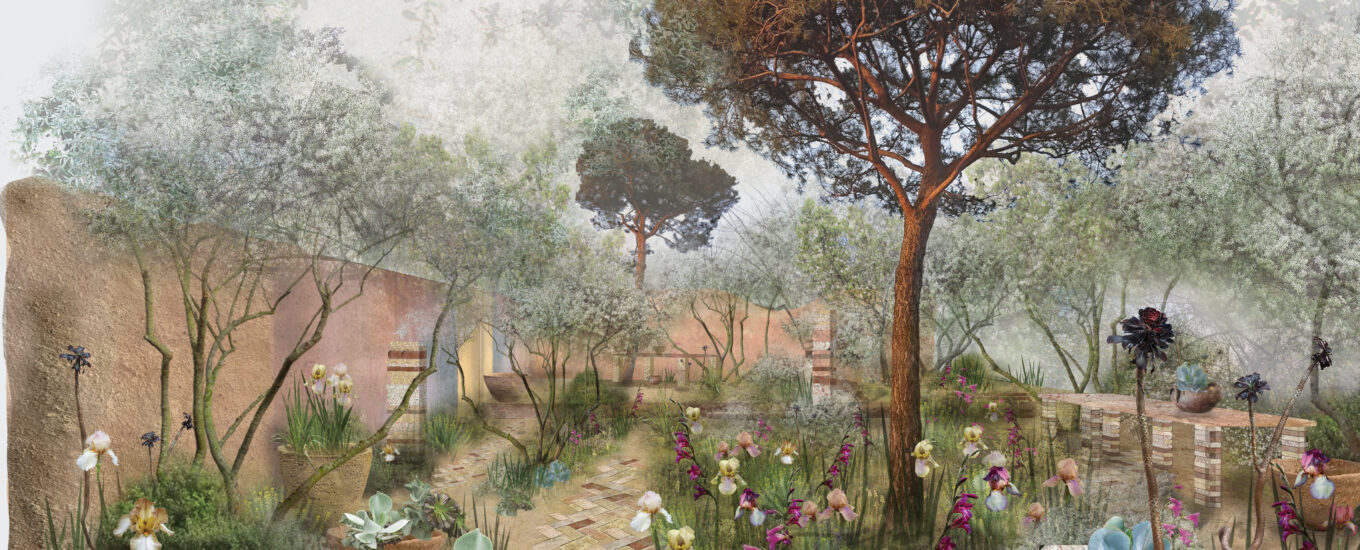
The Nurture Landscapes Garden
Joanna Fortnam explores how Sarah Price and her team for the Nurture Landscape Garden are pushing the boundaries of how sustainable a show garden can be. 

Creative Sparks
One April, just after Benton’s transfer to the Garden Museum, Sarah visited and was blown away by “Cedric’s ghosts” – abundant drifts of spring bulbs that had run riot during the garden’s abandonment: fritillaries, Anemone pavonina, snowflakes, aconites and nectaroscordum bejewelled the long grass, skirted the overgrown shrubs and popped up in a woodland spinney. She says: “Benton is an enchanted garden, not necessarily an unusual one but many people can relate to it. It has the atmosphere of a place that has been incredibly loved, like a corner of childhood.” As a former art student, Sarah’s designs tend to start with a painting rather than a plan and the abundant drifts of flowers sparked a moment of recognition: “The garden was the closest thing I’ve ever seen to a Botticelli painting – the flowery mead.” Certain works by Cedric Morris also influenced her design: “The rich and unusual palette of pink, yellow and blue in two paintings (Cotyledon and Eggs, and The Eggs) inspired my first conceptual ‘mood’ drawing of the garden,” she says. Another fortuitous thought occurred: Sarah made an early decision that all the plants used in her Chelsea showpiece would come back to Benton to help with the revival of the garden.
What will we see at Chelsea?
Rather than replicating Cedric’s garden, Sarah aims to celebrate him in spirit using her outstanding eye for plants and colour. Walls, paths, planters and hard landscape are constructed in materials and textures reminiscent of the house at Benton End. Boundaries of richly coloured canvas and walls made from straw bales provide a backdrop that sets the tone and atmosphere. The multi-layered, ‘wild’-looking planting is Sarah’s signature balance of seemingly accidental beauty contrasted with carefully edited spaces where the hand of the gardener is evident, for example succulents growing in raised planters and potted plants set on a large, worn table, a place for gathering (it may also feature some old kitchen chairs, to evoke the art student days of the 50s). 
 Benton iris in 11 different varieties are a highlight, the flowers appearing almost suspended over ground cover plants and lighting up a grove of elegantly pruned silver elaeagnus. Certain Morris-bred plants such as his grey-toned poppies and the sweet pea ‘Cedric Morris’ may also put in an appearance. Peter Clay of Crocus is responsible for sourcing and growing the plants. As ever, he is working with a few key nurseries (Beth Chatto, Howard’s), to ensure that he has enough plants looking good for the show in May. “The iris are the main manifestation of Cedric Morris’s influence,” he says. “We’re growing them for the first time so it’s really difficult. What happens from March onwards is the key – we need the light and temperature to be consistent.” He reckons that the iris will be “seen in a slightly different frame of reference to the way Cedric used them… showing how the best modern designers can use these beautiful plants that have been overlooked by other trends in gardening.” Another key member of Team Price is design practice Local Works Studio, based in Sussex. Co-Director Ben Bosence is an expert in the conservation of historic buildings. Ben has long experience of materials and an understanding of how traditional crafts can be applied to present day projects. He, like Sarah, is also a former fine art student, and collaborated on her design for a Maggie’s Centre garden in Southampton. For that project, he devised a way of upcycling old fire hoses into outdoor furniture with a cool Italian modernist vibe. This might not be what you’d expect from a conservation expert, but so much of sustainable design is a case of learning from tradition. Ben is just as comfortable producing modern furniture and terrazzo paving as he is working with wattle and daub walls and handmade paint – but he is strict about where materials come from.
 “Our work is all about the ingenuity and creativity required to build with limited resources. The idea is that you can produce what you need wherever you are,” he says. To this end, he is always searching – poking around building sites, eyeing roadside repairs and rummaging through skips (he met his partner, landscape architect Loretta, over a skip). Typically, on a walk around the Crocus nursery, he spotted some piles of broken terracotta pots and leftover sand and happily requisitioned both to use on the Chelsea garden.
Construction Changes
Right from the start, the question of how to make a Chelsea garden sustainable drove the logistics. As Sarah acknowledges, this was the hardest part of the process because so little data or methodology is available to assess the carbon footprint of garden construction. However, everyone was up for the challenge, including Mark Fane who, as a Chelsea veteran, might have been inclined to be sceptical. But far from waxing nostalgic about the glory days of ordering in trees from Belgium and container-loads of stone from India, he says: “We need to be a lot tougher on ourselves, those days are over.” He recalls: “It was a team decision to create a rod for our own backs. We must challenge ourselves. I always sit down after every Chelsea and ask ‘what could we do better? The minute we stop doing something better it’s time to go home.” He has always felt strongly that genuine craft skills deserve greater recognition: “I’m a big believer in the lost art of craftsmanship – we’re so tuned in to just taking something off a shelf. We value design so highly – but not workmanship. Wouldn’t it be great if Chelsea was to give a bricklayer or a stonemason a prize?” Before so much as a plant pot was moved, the team had to establish the logistics of working with a low carbon footprint. They agreed to focus the main part of production to a restricted travel corridor between Crocus and Chelsea. They were limited to using either local materials or reusable waste materials to build the garden. The idea was to stick with building methods as simple and accessible as possible: bricks for paving and pillars are being made from waste aggregates at the Crocus site. The straw bale walls will be made in situ at Chelsea, then be rendered and painted using plant-based paints made by Ben from a traditional Scandinavian recipe. Planters can be cast very simply by digging a hole in the ground and pouring in the aggregate mix. 
 Some prefabrication is possible too: old canvas backdrops sourced from scenery painters are being repainted and repurposed to form a garden boundary; dead hop vines have been collected for cordage, i.e. weaving into a perimeter rope (brambles, bindweed and nettles can also be turned into tough fibres).
 Sustainable design is a tough subject. The usual objection is that a large event such as Chelsea Flower Show can’t ever be properly sustainable given the amount of material that has to be moved into place – and then out again. In terms of transport and energy the carbon footprint is huge. However, many changes can and are being made to limit waste, especially now that so many designers, like Sarah Price, want no part of disposable garden making. It’s also important to acknowledge the value of Chelsea as a platform that can bring sustainable garden design to a wider audience and offer inspiration and practical know-how. In any case, increasing numbers of garden designers are willing to take on the challenges and, on the Nurture Landscapes garden, the ingenuity and creativity of Sarah Price and her collaborators will be genuinely exciting to contemplate.
—
For more information: sarahpricelandscapes.com
Nurture Landscapes Limited
Nurture Landscapes (The Nurture Group) is a multi-award-winning national service provider consisting of three established companies providing ‘one stop’ integrated services to a wide and diverse client base across the UK, providing grounds maintenance, interior and exterior plant displays and winter gritting to a wide range of clients predominantly to the corporate sector. The Group’s aim is to be the UK’s leading green service provider achieving net zero by 2030. As a carbon neutral business in accordance with the global PAS 2060 standard, delivering sustainable, industry leading services and endeavours to build lasting relationships with its customers, colleagues, and supply partners. The group’s head office is in Windlesham, Surrey, and it has a network of regional offices and depots across the UK. The business has grown as the result of both organic growth and a successful acquisition programme. Having been a member of the British Association of Landscaping Industries (BALI) for more than a decade, The Group has gained a strong reputation through numerous industry awards, in addition to being included in the Sunday Times Fast Track 100 List of Companies and the LSEG’s Companies to Inspire Britain several times. Committed to developing, training and retaining their people and is a Real Living Wage employer, providing opportunities for apprentices within customer communities.